


Drive through Westchester or any outer borough on a Tuesday afternoon and you’ll pass more branded work trucks than you’d think. That’s not an accident. Fleet wraps for Westchester and NYC service businesses have become the default move for HVAC companies, plumbers, electricians, and landscapers who realized their vehicles were sitting in driveways for hours doing absolutely nothing for the brand. A wrap changes that math. Here’s what actually goes into a fleet wrap program, how to think about coverage levels, and what holds up over years of New York weather.
Why Fleet Wraps Outperform a Painted Logo for Service Businesses
Quick answer: a fleet wrap turns a work van or truck into constant, paid-for advertising instead of a rolling reminder of an unfinished paint job. Before you request a quote, here’s what actually moves the needle for Westchester and NYC service businesses:
- Coverage level (full, partial, or decals) matters more for cost than vehicle size does.
- Cast vinyl with laminate lasts 5 to 7 years under normal New York conditions, calendared vinyl lasts closer to 2 to 3.
- Wrapping your highest-visibility vehicle first lets you validate the design before committing the whole fleet.
- DOT and license-number requirements should be built into the layout from day one, not added as a sticker afterward.
A plumbing van parked outside a job in New Rochelle gets looked at whether the owner wants it to or not. So does a landscaping truck idling on a Westchester side street. A fleet wrap just turns that unavoidable attention into something useful. A well-designed wrap on a service vehicle can rack up thousands of impressions a day doing nothing but the normal rounds, and it carries a lot more than a painted door logo ever could: colors, phone number, service list, a QR code straight to the booking page.
For service businesses, HVAC, plumbing, electrical, landscaping, pest control, the math works differently than it does for a delivery fleet. A delivery van gets seen in motion for a few seconds at a time. A service van sits in a driveway for two hours while someone replaces a water heater. That dwell time is what makes a wrap on a repair van worth more per vehicle than the same wrap on a truck that only ever gets glanced at on the highway.
What a Fleet Wrap Program Actually Includes
A fleet wrap program isn’t one wrap copy-pasted onto every truck. It starts with a design system: a master template built once and adapted to each vehicle model, so a cargo van, a pickup, and a box truck all read as the same brand even though their proportions have nothing in common. We build that master file first, then produce vehicle-specific proofs so panel lines, door handles, and wheel wells are accounted for before anyone cuts vinyl.
Production covers color-matched vinyl, a laminate layer for UV and scratch protection, and install instructions specific to each vehicle type. That matters more than it sounds for companies adding trucks over time. A landscaping company buying a second truck in spring isn’t starting from zero, the master template is already on file, so wrap number two goes faster and costs less than wrap number one did.
Choosing the Right Coverage Level for Your Fleet
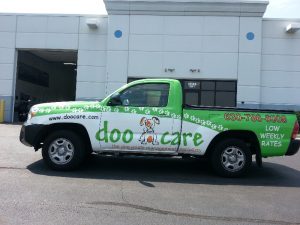
Full wraps cover the entire vehicle and give the strongest brand presence, good for a lead vehicle or a fleet that wants every truck looking identical. Partial wraps cover somewhere around 30 to 60 percent, hood, rear panels, lower sections, and cost less per vehicle while still reading clearly at a stoplight. Decals are the lightest option: logo, phone number, license numbers where the state requires them, appropriate for a utility trailer or a secondary vehicle that doesn’t need the full brand treatment.
The existing section above covers the general logic. Here’s the side-by-side most fleet owners actually want before they call:
| Coverage | Approx. Coverage Area | Best For | Install Time | Longevity (NY conditions) |
| Full Wrap | 90-100% of body panels | Lead vehicles, high-visibility routes | 1-2 days per vehicle | 5-7 years, cast vinyl with laminate |
| Partial Wrap | 30-60% of body panels | Mixed fleets balancing cost and reach | 4-8 hours per vehicle | 4-6 years, same vinyl grade |
| Decals/Lettering | Logo, phone number, DOT panels only | Utility vehicles, secondary trucks | 1-3 hours per vehicle | 3-5 years depending on placement |
Most Westchester and NYC fleets don’t pick one tier for every vehicle, and that’s the right call, not a compromise. A plumber running four trucks might full-wrap the newest van for job-site parking and neighborhood routes, partial-wrap two mid-fleet trucks, and stick with decals on the oldest utility truck that’s closer to replacement anyway. Matching coverage level to how visible and how long-lived each vehicle actually is gets more brand impact per dollar than wrapping everything identically.
One factor the coverage level alone doesn’t capture: window perforation. Rear and side window perf adds visible branding without blocking a driver’s view, and it’s worth specifying separately from body panel coverage when you request your quote, since it’s priced and installed
Design Considerations That Keep a Fleet Consistent
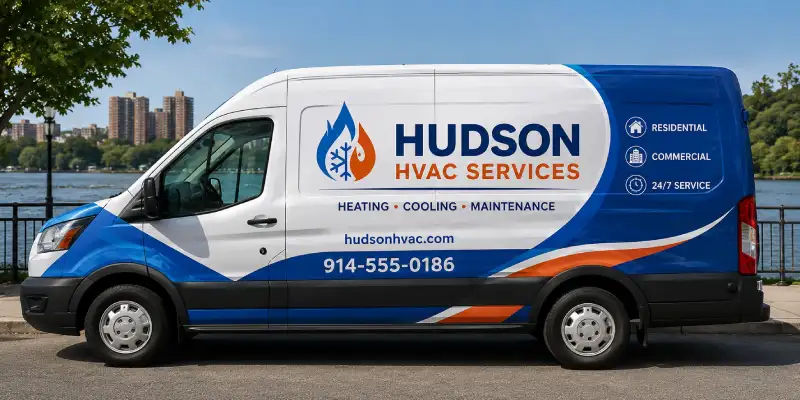
A fleet wrap has to work at three distances at once: readable from a moving car forty feet away, recognizable across a parking lot, and detailed enough up close that someone standing on their porch can find the phone number without squinting. That means large type for the name and number, smaller type for the service list, and enough breathing room that the design isn’t competing with door handles and gas caps and side mirrors for space.
One thing that trips up more fleets than you’d think: the cargo van’s blue doesn’t quite match the pickup’s blue because of a printer color shift nobody caught in time. Sounds minor. A fleet that looks slightly mismatched reads as unplanned rather than professional, and customers pick up on that even when they can’t say exactly why. Locking a Pantone-matched palette before anything goes into production fixes it, and every truck added to the fleet later actually matches the ones already on the road.
Mistakes We See Service Businesses Make With Fleet Wraps
A few patterns show up often enough in Westchester and NYC fleets that they’re worth naming directly. The first is designing for the parking lot instead of the road: a layout that looks balanced on a laptop screen can read as cluttered at 35 miles per hour, because there’s no time to process small text or a busy background pattern. We design and proof at the size and distance a wrap actually gets seen.
The second is treating the wrap as a one-time project instead of a template. Businesses that order one van at a time, with a slightly different layout each time because the person requesting it changed or the file got lost, end up with a fleet that doesn’t read as one company. Locking a master template the first time, even if only one vehicle gets wrapped immediately, saves real money and design time on every vehicle that follows.
The third is skipping maintenance guidance. A wrap that gets touchless-washed weekly and hand-dried after winter driving holds its full 5-to-7-year lifespan; one that goes through a brush car wash every week or sits under direct sun with no washing at all often needs attention well before that. We send every client the same care sheet for a reason, it’s the cheapest way to protect an investment that’s already been made.
Durability, Maintenance and What to Expect Over Time
Cast vinyl with a laminate finish typically holds up five to seven years under normal New York weather, winter road salt included, though vehicles driven hard every day or parked in direct sun a lot will land closer to the five-year end. Hand washing and touchless car washes are kind to a wrap. Brush washes are not, they lift edges over time, especially around mirrors and door seams.
Small scratches and edge lifting are just normal wear, and they can usually be patched without re-wrapping the whole vehicle, which matters more than people expect since pulling a truck out of rotation for a full re-wrap costs real money in missed jobs. A quick look every few months, particularly around wheel wells and door edges, catches the small stuff before it turns into the expensive stuff.
How to Think About Fleet Wrap ROI (Without the Guesswork)
Fleet wrap ROI is hard to pin to one number, and any pitch that hands you a precise cost-per-impression figure without asking about your routes is doing math it can’t actually back up. What you can control, and what’s worth thinking through before you commit budget, is cost per year of visible use.
Divide the total wrap cost by the years it realistically holds up under your driving conditions (see the durability ranges above), and compare that to what you’re already spending on other local advertising, a directory listing, sponsored social posts, a truck-side magnetic sign that peels off in winter. For most service businesses, a wrap that lasts five years and gets driven daily works out to a lower annual cost than recurring paid ads, and it keeps working during months when the ad budget gets cut.
The other side of ROI is harder to put a number on but shows up eventually: a wrapped van parked at a job site all day is a passive lead generator in a way a painted logo isn’t, neighbors notice it, and “the truck I keep seeing” is a real reason people give for calling a contractor. We’d rather walk you through that reasoning honestly than hand you a stat we can’t stand behind.
Fleet Wraps and DOT or Company ID Requirements
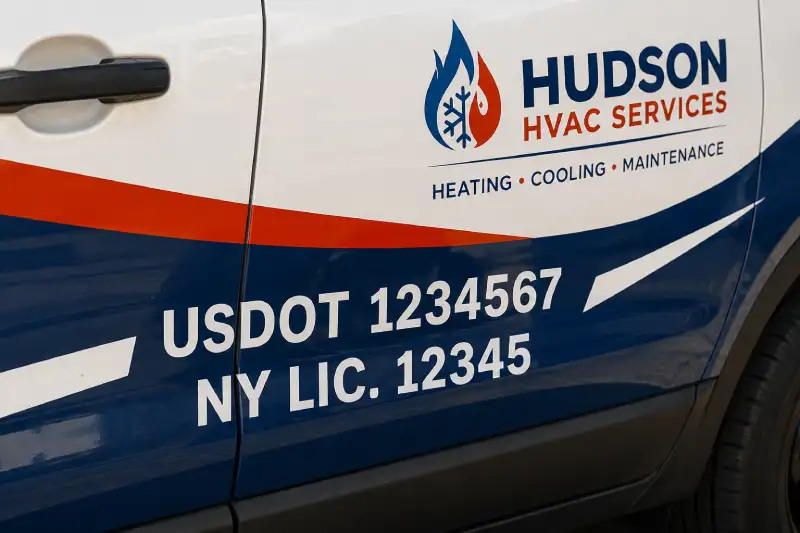
Some trades, plumbing and HVAC among them, are required to display company name, license number, or DOT identification on the vehicle itself. A fleet wrap can build that requirement into the design so it sits cleanly inside the brand layout instead of looking like a compliance sticker slapped on as an afterthought. Worth raising early, since retrofitting compliance text onto a finished design almost never looks as clean as building it in from day one.
If a fleet crosses county lines, or into a neighboring state from a Westchester base, it’s worth checking whether any destination-specific marking rules apply. Requirements shift more than people expect, even within the greater New York area.
Getting Started With a Fleet Wrap Program
The fastest way to get a first proof moving is a short call: fleet size, vehicle makes and models, and whether the company wants to wrap everything at once or start with one or two trucks to confirm the design first. We handle design, color matching, production, and install from one point of contact, so a growing Westchester or NYC service business isn’t juggling a designer, a print shop, and an installer as three separate conversations.
Our usual recommendation is to start with whichever vehicle gets the most daily visibility, often the lead technician’s van, so the design can be judged on an actual truck before committing to the rest of the fleet. Once that first one’s approved, the rest move quickly since the template and color specs are already locked in.
Where We Wrap Fleets Across Westchester and NYC
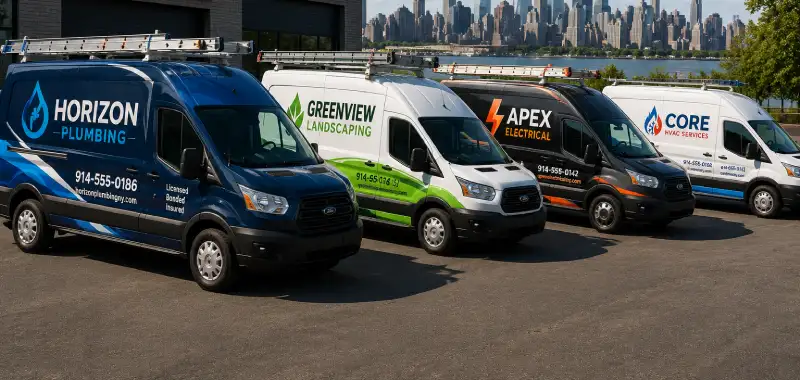
Fleet wrap installation is a same-day trip for most of the businesses we work with. We regularly wrap and service vehicles for HVAC, plumbing, electrical, and landscaping companies based in New Rochelle, White Plains, Yonkers, Mount Vernon, and Scarsdale, along with contractors who cover routes across all five NYC boroughs, Manhattan, Brooklyn, Queens, the Bronx, and Staten Island, from a home base in Westchester.
That geographic spread matters for two practical reasons. First, a fleet that works both Westchester suburbs and NYC boroughs needs a wrap design that reads clearly at suburban driving speeds and holds up to stop-and-go city traffic and tighter parking, which is a different visibility test than a wrap that only ever sees highway miles. Second, vehicles that cross into New York City are more likely to trigger additional local marking or company ID requirements depending on the trade, so we check destination-specific rules during design instead of treating it as an afterthought.
If your fleet operates out of a Westchester base and works job sites across the county line into the city, tell us your typical routes when you request a quote. It changes how we’d recommend prioritizing which trucks get wrapped first.
Vehicle Prep Checklist Before Your Wrap Appointment
A little prep on your end keeps installation on schedule and protects the finish underneath. Before your fleet’s wrap appointment:
- Wash each vehicle thoroughly 24 to 48 hours before drop-off. Vinyl won’t adhere properly over road grime, and washing the same day can leave moisture trapped under panels and door seams.
- Remove roof racks, ladder mounts, and anything bolted to the body that isn’t staying on permanently. It’s faster and cheaper to wrap around fixed equipment than to work around something that gets removed later.
- Flag any existing dents, rust spots, or touch-up paint. Vinyl doesn’t hide body damage, it actually draws more attention to uneven panels under certain lighting, so we’ll tell you honestly if a repair should happen first.
- Confirm your DOT number, license number, or any required company ID text before design starts, not after proofs are approved. Adding required text late usually means reworking a layout that was already finalized.
- Plan for the vehicle to be off the road for the full install window. Staggering a multi-vehicle fleet across a week or two keeps most of your trucks running while each one gets wrapped.
None of this is complicated, but skipping it is the most common reason an install runs long or a wrap doesn’t hold as well as it should.
Fleet Wrap FAQs for Westchester & NYC Service Businesses
1. How much does a fleet wrap cost per vehicle in the New York area?
Cost depends on vehicle size and coverage level (full wrap, partial wrap, or decals), plus how much of the design work is custom versus adapted from an existing brand system. Request a fleet quote and we will price it against your specific vehicle list.
2. How long does a fleet wrap last?
A cast vinyl wrap with laminate protection typically lasts 5–7 years under normal New York driving and weather conditions. Vehicles parked outdoors in direct sun or driven daily in winter salt tend toward the shorter end of that range.
3. Can you wrap vehicles that are already branded with a different design?
Yes. Old wraps and vinyl lettering are removed before the new wrap goes on, and we inspect the paint underneath for any adhesive residue or damage that needs addressing first.
4. Do you handle fleets with mixed vehicle types, like vans, pickups and trailers?
Yes, most fleets we produce for include a mix of vehicle types. We build one master design system and adapt it to each vehicle model so the fleet reads as consistent regardless of body style.
5. How long does installation take for a full fleet?
A single full wrap typically takes one to two days per vehicle depending on size and complexity. For multi-vehicle fleets, we can stagger installation so not every truck is off the road at the same time.
6. Do fleet wraps require any special permits in New York or Westchester?
Vehicle wraps generally do not require municipal signage permits since they apply to the vehicle rather than a fixed structure, but we flag any DOT or company-specific vehicle marking requirements relevant to your industry during the design phase.
7.Do fleet wraps affect vehicle insurance?
Wrapping a vehicle doesn’t typically change your insurance rate on its own, since insurers price policies around the vehicle and driver, not the exterior finish. That said, always confirm with your insurance provider before wrapping, especially for leased vehicles, since some lease agreements have their own requirements about exterior modifications.
8.What condition is the paint in after a wrap is removed?
Paint underneath a properly installed and properly maintained wrap is usually in the same condition it was before, sometimes better protected from UV fading than paint that was never wrapped. The exceptions are vehicles with existing paint damage or oxidation before the wrap went on, which is why we inspect and flag any pre-existing issues during the prep walkthrough.
9.Can we start with one vehicle and add the rest of the fleet later?
Yes, and it’s what we recommend for most first-time fleet wrap clients. Wrapping one vehicle first lets you confirm the design, color match, and placement in person before committing the rest of the fleet, and the approved template makes every vehicle after the first faster and slightly less expensive to produce.