
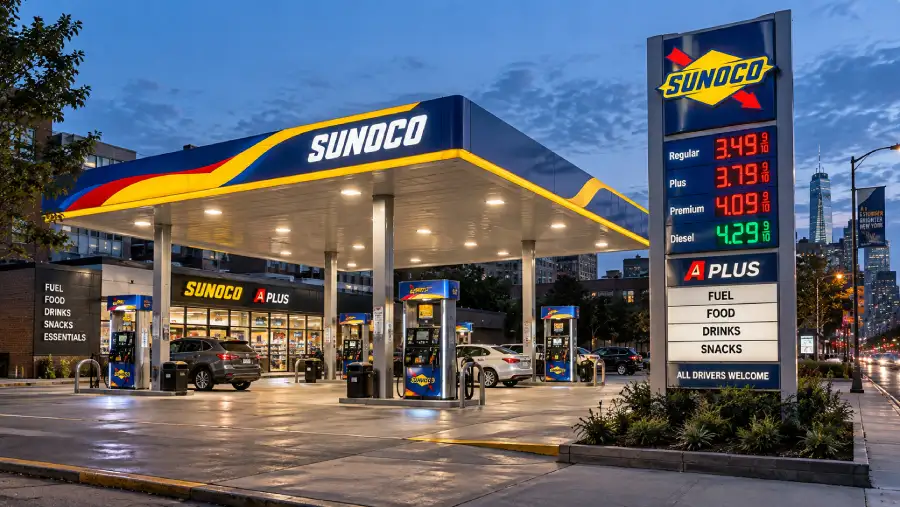
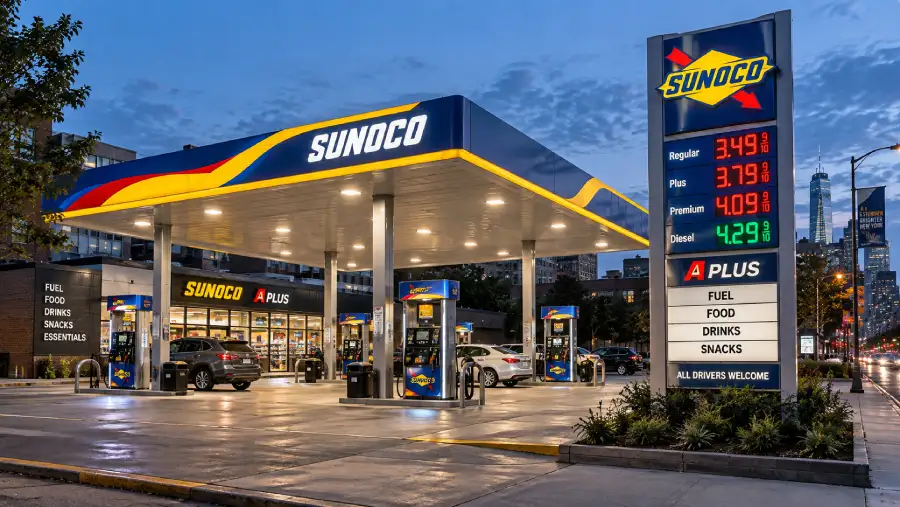
A driver deciding whether to pull off at your station has about three seconds to make that call, and most of that decision happens before they’re anywhere near your pumps. Pole signs, canopy lighting, and price displays do that job from the road. Once they’re parked, a second signage job starts inside the store, and it’s the one most gas stations get wrong: the grab-and-go case and the beer cave, the two highest-margin areas in the building, often get the least signage attention of anywhere on the property.
Exterior Signage That Gets Drivers Off the Road
Gas Station Sign Types at a Glance
| Sign Type | Main Purpose |
| Pole Sign | Long-distance visibility |
| Canopy Sign | Pump-area branding |
| Pylon Sign | Mid-range visibility |
| Fascia Sign | Storefront identification |
| LED Price Display | Fuel price visibility |
Different exterior signs work together to guide drivers from the road to the pump.
The exterior signage package for a gas station has to do double duty: brand recognition from a distance, and legible pricing up close, often while a car is moving at 30 or 40 miles an hour.
Pole signs remain the primary long-distance visibility tool, especially on highway-adjacent or high-speed corridor locations where a driver needs to spot the brand and price well before their exit. Canopy signage, the branding and lighting built into the fuel canopy itself, is what carries that visibility into the property once a driver has already committed to pulling in, and it does the added job of lighting the pump area for nighttime safety. Pylon and fascia signs fill in the mid-range visibility gap between the two.
If you’ve searched for a gas station sign pole for sale, it’s worth knowing that most professional installations aren’t built from stock hardware. Pole height, sign cabinet size, and price-display configuration are typically custom-fabricated to match your specific site’s setback, sightlines, and local sign code, which is a different process than buying an off-the-shelf pole and mounting a sign to it.
LED illumination has mostly replaced fluorescent and neon for both pole signs and canopy lighting at this point, largely because it holds up better over years of continuous nighttime operation and typically costs less to run.
Interior Convenience Store Signage Most Gas Stations Overlook
Grab-and-Go vs. Beer Cave Signage
|
Grab-and-Go Case |
Beer Cave |
| Product category signs | Category headers |
| Meal labels | Promotional graphics |
| Quick-decision messaging | Seasonal campaigns |
| Brand consistency | Cooler-door wayfinding |
Small interior signage updates can improve navigation without requiring a full store redesign.
Exterior signage gets a driver into the parking lot. Interior convenience store signage decides whether that same customer spends five dollars or twenty five once they’re inside, and this is the area that tends to get the least planning.
Grab-and-go case signage is the clearest example. The case sits near the register, it’s high-traffic by definition, and yet it’s frequently signed with whatever came from the case manufacturer rather than anything that matches the store’s actual branding or actually calls out what’s inside (sandwiches versus salads versus prepared meals, for instance). Clear, branded case signage does two things a generic label doesn’t: it speeds up decision-making for customers in a hurry, and it gives the case a merchandised look instead of a purely functional one.
Beer cave and cooler signage is the other frequently underused area. A beer cave or multi-door cooler bank is often the single largest continuous run of interior wall space in the store, and it’s usually covered in manufacturer-branded cooler doors with little of the store’s own signage layered on top. Category signage (craft versus domestic, singles versus cases), promotional signage for seasonal or local products, and simple wayfinding above the doors all do real work in a section that customers often browse for longer than anywhere else in the store.
Neither of these areas needs an overhaul. Most of the value comes from a focused signage pass on the case and the cooler bank specifically, rather than a full store redesign.
Price Signage: What New York Gas Stations Need to Get Right
Fuel price signage is one of the more scrutinized parts of a gas station’s exterior, and it’s worth treating as its own line item rather than an afterthought to the pole sign.
Legibility from the road is the first practical requirement: digit height, contrast, and illumination all need to work together so a driver moving at speed can actually read the price before deciding whether to turn in. LED price displays have become the standard here because they stay legible in direct sunlight and after dark, which older backlit or manual-digit displays often don’t do as well.
Placement and format expectations can vary by municipality and by whether a station is on a state highway versus a local road, so it’s worth confirming specific requirements with your local building or sign code office, and with a sign company that has fabricated price displays for other New York stations before, rather than assuming one station’s setup is automatically compliant everywhere else.
Choosing a Sign Company for a Gas Station or Convenience Store
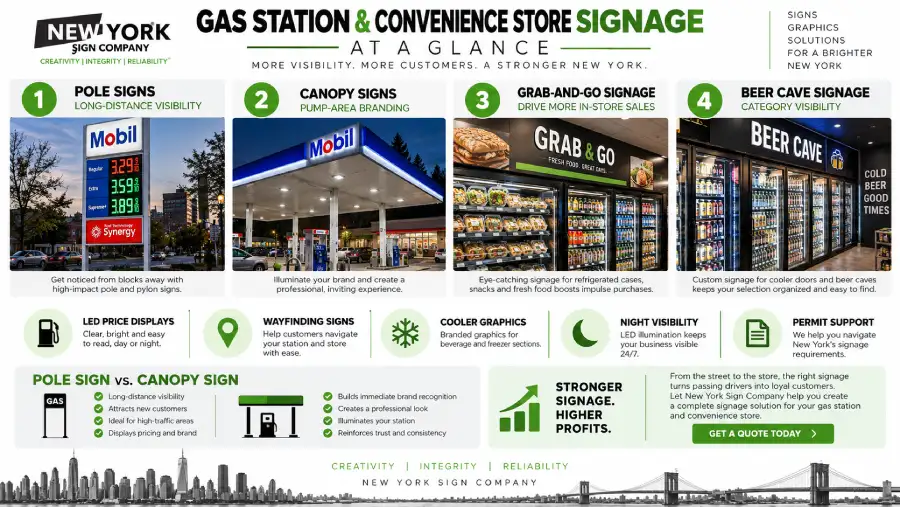
A station and its attached store are really two different signage jobs under one roof, which narrows the list of vendors worth calling.
Look for a company that can speak to pole and canopy fabrication specifically, not just general exterior signage, since sizing, structural mounting, and price-display integration are a different discipline than a standard storefront sign. On the interior side, ask whether they’ve actually worked on grab-and-go case or cooler signage before, since that’s a narrower specialty than general retail signage and it shows in how well the finished signage actually fits the fixtures. If your location needs permit coordination for a pole sign or a canopy modification, a company that has already worked with your local code office will generally move faster than one starting from scratch.
Combining Fuel and C-Store Branding Without Visual Clutter
Most New York gas stations are really combo properties: a fuel brand out front and a convenience store brand (sometimes the same company, sometimes a franchise partner) attached to it. Treating those as two unrelated signage projects is a common way stations end up with a cluttered exterior, competing color palettes, and a customer who isn’t sure which brand they’re actually walking into.
The stations that get this right usually plan the fuel signage and the store signage together from the start: a consistent color and typography approach that carries from the pole sign through the canopy and into the store’s own exterior signage, so the property reads as one destination rather than two brands sharing a parking lot.
Frequently Asked Questions
What’s the difference between a pole sign and a canopy sign for a gas station?
A pole sign is a freestanding sign, usually elevated, built for long-distance visibility from the road. A canopy sign is integrated into the fuel canopy structure itself and does double duty as branding and pump-area lighting once a driver has already pulled onto the property.
Can I just buy a gas station sign pole and install it myself?
Most stations don’t, mainly because pole height, cabinet size, and price-display integration typically need to be custom-fabricated to the site’s setback and local sign code, rather than assembled from stock parts. It’s worth getting a fabricator involved from the design stage rather than after a pole is already purchased.
What signage does a beer cave or cooler section actually need?
At minimum, clear category signage (so customers can find what they want without opening every door) and some brand-consistent signage layered over the manufacturer cooler-door branding. Promotional or seasonal signage on top of that is optional but tends to perform well in a section customers already browse.
Do gas station price signs have to meet specific size or legibility requirements in New York?
Expectations can vary by municipality and by road type, so it’s worth confirming specifics with your local code office and with a sign company that has fabricated price displays for other New York stations. LED displays are the current standard for keeping prices legible in both daylight and darkness.
Should a gas station and its attached convenience store use matching signage?
Generally yes. Planning the fuel and store signage together, same color palette and typography from the pole sign through the interior, tends to read as one cohesive destination rather than two brands sharing a lot, and it usually costs less than fixing mismatched signage after the fact.