
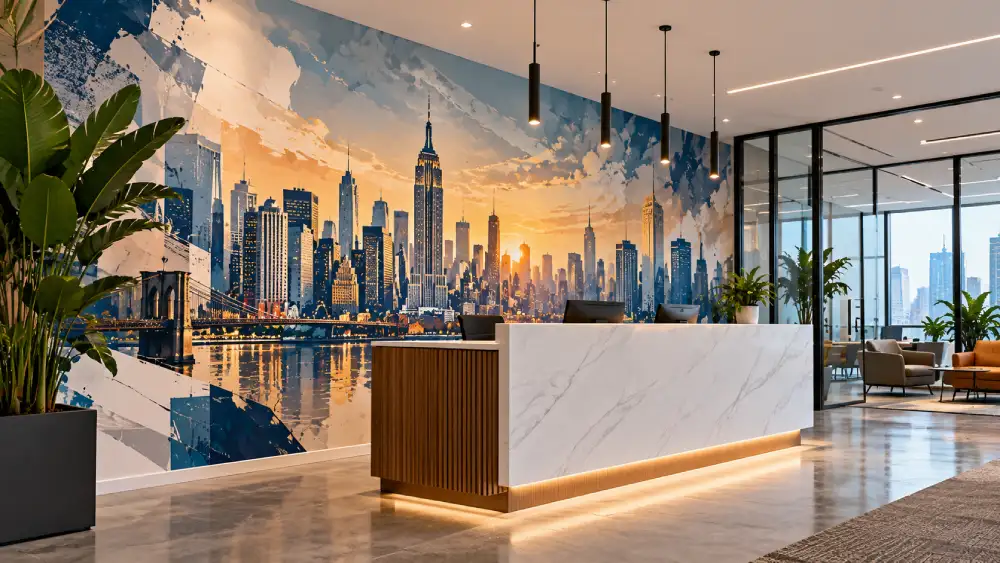
Office wall murals in NYC and Westchester do two jobs at the same time. For clients and candidates, a mural answers the question “who is this company?” before anyone at the front desk says hello. For employees, it makes the office feel like their place instead of a rented floor, which matters more now that most teams decide for themselves how often to come in. Most companies choose printed vinyl murals over paint, because vinyl installs in a day or two, can be specified to meet building fire requirements, and comes off cleanly when the lease ends.
New York Sign Company has been producing signage and wall graphics for New York businesses since 1996, from Midtown towers to office parks in White Plains and Harrison. This guide is built from that work. It covers which walls deserve a mural, how branding murals and culture murals differ, what Manhattan building managers ask for that Westchester landlords often don’t, and how to brief a mural so the first design round isn’t wasted.
Key Takeaways
- The walls that earn a mural are the ones people actually look at: reception, conference rooms (including the wall behind the video camera), and the hallways and break areas staff pass every day.
- Branding murals speak to visitors. Culture murals speak to employees. The strongest office murals manage both without reading like an ad.
- Printed vinyl is the practical default for leased NYC offices. It installs fast, comes down at move-out, and is available in Class A fire-rated materials.
- Manhattan buildings usually ask for a certificate of insurance, after-hours installation, and fire-rating paperwork. Westchester office buildings tend to allow more scheduling flexibility and bigger walls.
- Let employees help shape the concept. University of Exeter researchers found people working in spaces they had a say in were up to 32% more productive.
Table of Contents
- What Is an Office Wall Mural?
- How Companies Use Office Wall Murals for Branding
- How Office Murals Support Company Culture
- Where Office Murals Work Best, Room by Room
- Office Murals in NYC vs. Westchester: What Changes
- How to Plan an Office Wall Mural Project
- Office Wall Mural Questions, Answered
- Planning a Mural for Your Office?
What Is an Office Wall Mural?
An office wall mural is a large-scale graphic, printed or painted, that covers most or all of a wall in a workplace and is sized to that exact surface. The difference from framed art or a logo sign is scale: the mural becomes the wall instead of something hung on it.
Three formats cover nearly every commercial office project in New York:
| Format | How it’s made | Best for | Watch out for |
| Printed vinyl mural | Printed in panels on adhesive film, laminated, applied on site | Leased offices, brand walls, tight timelines | Needs smooth, fully cured paint underneath |
| Printed wallcovering (mural wallpaper) | Printed on commercial wallcovering stock and hung with paste | Long-term installs, textured finishes | Harder to remove; building may ask for fire documentation |
| Hand-painted mural | Painted on the wall by an artist | One-of-a-kind art commissions | Days on site, can’t be reproduced exactly, stays with the building |
Wall decals are the smaller relative: a logo, a values statement, or a line of lettering cut from vinyl, with the painted wall showing around it. Many offices use both, a full mural on one feature wall and custom wall decals and wall graphics carrying the same colors and icons down the corridors. That pairing usually costs less than covering every wall, and it looks more deliberate.
Painted murals have their place, especially for one-off art commissions. For most offices, though, printed vinyl wins on schedule and flexibility. A painter may need several days on site. A printed mural is produced off site and installed in one to three days depending on size, and the same file can be reprinted for a second office or a replacement panel.
How Companies Use Office Wall Murals for Branding
Branding murals work on the people who don’t work there yet: prospective clients, job candidates, investors, vendors. They form an opinion about a company in the first minute inside the door, and the walls are a big part of what they see. A logo sign tells them the name. A mural tells them what kind of company it is.
The reception wall
Reception is where most companies start, and for good reason. It’s the one wall every visitor sees. Common approaches include a brand story wall (founding year, signature projects, the product in use), a large photographic image tied to the business (a skyline for a real estate firm, a job site for a construction company), or an abstract pattern built from the brand’s own colors and shapes.
A setup that works well in New York lobbies is a printed mural as the background with dimensional letters mounted on top. The mural gives the logo context, and the letters give the wall a depth a flat print can’t. Our guide to lobby sign ideas for Westchester and NYC corporate offices covers the sign side of that combination in more detail.
Finish quality matters more here than anywhere else in the office. When an executive search firm brought us in to brand their new space on Park Avenue, what they mentioned afterward wasn’t only the design. It was the speed of the job and the quality of the finish. That’s typical of client-facing walls. A seam that doesn’t line up or a corner starting to lift says more about a company than the artwork does.
Conference rooms and the wall behind the camera
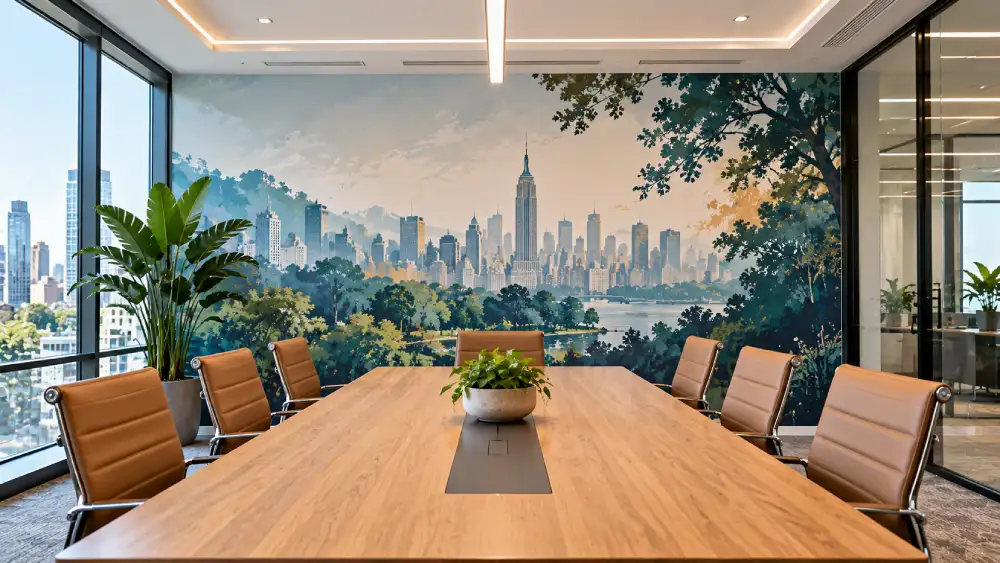
Conference rooms are where clients sit the longest, so a mural there gets studied, not glanced at. Law firms and financial offices tend toward calm imagery in brand colors. Agencies and tech companies often use the room to show their work.
One use that gets overlooked is the wall behind the video camera. In a hybrid office, more clients may see that wall on screen in a month than walk through reception in a year. Keep the area at head height simple so faces don’t get lost against a busy pattern, put the logo where the camera frame actually lands, and check the colors on a test call before approving the final proof, since webcams tend to wash out pale tones. If the room has glass walls, frosted window film with a cut logo handles privacy and carries the brand onto the glass.
Keeping the brand consistent across floors and offices
Companies with more than one location, say a Manhattan headquarters and a satellite office in White Plains, usually want both spaces to feel like the same company. Printed murals make that straightforward. The artwork is a digital file, so it can be resized for a different wall, color-matched to the same brand standards, and reproduced years later if a panel gets damaged. A hand-painted mural can be similar at a second site, but never identical.
How Office Murals Support Company Culture
Culture murals face inward. The audience is the people who walk past them every day, and that’s a tougher crowd than visitors. A slogan in six-inch letters starts to feel like an HR poster by the second week. The murals that hold up show something true about the company instead of announcing it.
There’s research behind the idea that the look of an office affects the people in it. A University of Exeter study published in 2010 compared workers in bare “lean” spaces with workers in spaces decorated with plants and pictures. The decorated group was 17% more productive. Workers who were allowed to help arrange their own space did better still, up to 32% more productive than the lean group (ScienceDaily, 2010). A mural isn’t the same as arranging your own desk, but the lesson carries over: decoration helps, and giving people a hand in it helps more.

Culture mural ideas that don’t feel forced
- Company history timeline. The founding year, the first client, the move into this office. New hires get context in a few minutes, and long-time staff get something to point to.
- Values shown, not stated. Instead of the word “Collaboration” in giant type, a collage of real team moments or projects the company is proud of.
- Local identity. A map of the neighborhood the office sits in, the Hudson for a river town office, or street photography from the borough. It ties the team to the place they work.
- Team-made artwork. Sketches, whiteboard drawings, or photos from employees can be cleaned up, vectorized, and printed at wall scale. People notice their own contribution every time they walk by.
- Industry details up close. Blueprints for an architecture firm, anatomical illustration for a medical practice, circuitry for a tech company. Staff recognize it right away, and visitors get the reference too.
One caution: a mural behind rows of desks should be calmer than one in a lounge. High-contrast, busy patterns in the line of sight of people doing focused work get tiring fast. Save the bold pieces for the break room, the reception wall, and the corridors.
Hybrid schedules have changed the brief as well. When employees can work from home, the office needs to give them a reason to come in. A floor that feels like the company’s own place, not a generic sublet, is part of that reason.
Where Office Murals Work Best, Room by Room
Not every wall deserves a mural, and covering every surface tends to cheapen all of them. Here’s how placement usually breaks down across a typical office floor:
| Space | Main job | What usually works |
| Reception and lobby | First impression, branding | Logo-forward design, strong contrast, dimensional letters over a printed background |
| Conference rooms | Client confidence, video backdrop | Brand colors, calm imagery, logo placed where the camera frame lands |
| Open workspace | Energy without distraction | Large shapes, low detail, softer colors on walls that face desks |
| Hallways and corridors | Culture and wayfinding | Timelines, department colors, floor and room identifiers |
| Break rooms and kitchens | Social culture | Local themes, team photos, bolder colors |
| Phone booths and focus rooms | Calm | Nature imagery, texture, minimal content |
Hallways deserve a special mention because they do double duty. A long corridor on a large floor is easy to get lost in, and a mural with department colors or floor identifiers works as quiet wayfinding signage while carrying the brand at the same time. Pair it with matching office signs on the doors and the whole floor reads as one system.
Two practical checks before you pick a wall. First, look at the furniture plan. A mural that disappears behind a credenza or a bank of filing cabinets is money spent on a wall nobody sees. Second, note everything mounted on the wall: thermostats, outlets, fire alarm pulls, TV brackets. The design should work around them instead of getting chopped up by them. For nature themes in quieter rooms, our post on tree wall decals for a calmer workspace has more ideas.
Office Murals in NYC vs. Westchester: What Changes
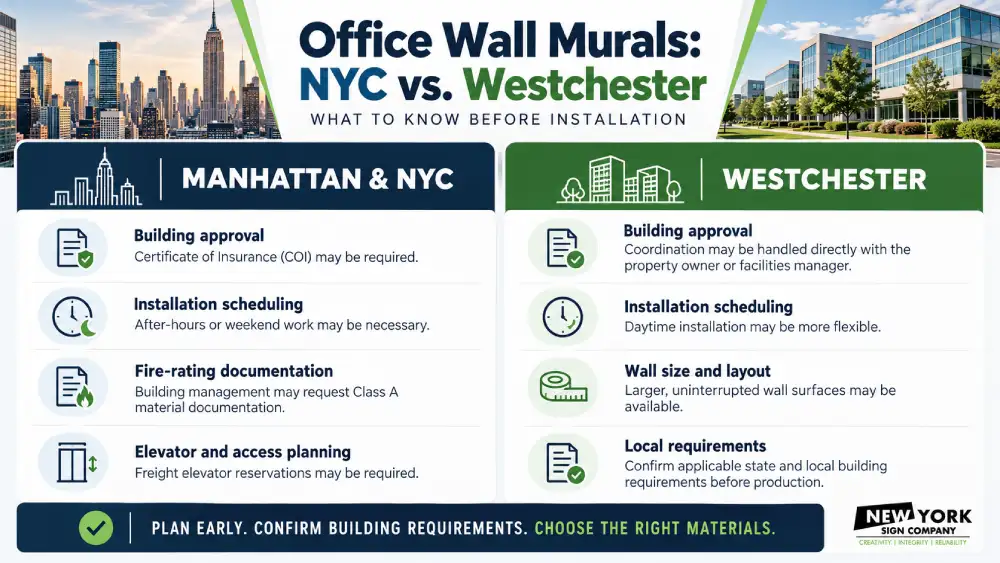
The design process is the same on both sides of the city line. The building side isn’t. These are the differences that most often affect timing and approvals.
Manhattan and the boroughs: the building has a say
Most managed office buildings in Manhattan treat a mural install like any other contractor job. Expect the building to ask for a certificate of insurance (COI) naming the landlord and management company before anyone sets foot on the floor. Many also require installs after business hours or on weekends, with the freight elevator booked ahead of time. Putting these into the schedule from day one keeps a finished mural from sitting in a box for a week.
Fire rating comes up often. The NYC Building Code (Section 803) classifies interior wall finishes using the ASTM E84 or UL 723 test, and Class A, the strictest category, means a flame spread index of 0 to 25 (NYC Building Code, Chapter 8). The same chapter exempts materials thinner than 0.036 inch applied directly to a wall, which covers most adhesive vinyl films. Even so, plenty of building managers ask for the material’s fire-rating data sheet before they approve an install. The easy fix is to specify a Class A rated film and laminate from the beginning, so the paperwork is ready when they ask.
Then there’s the end of the lease. Many commercial leases require tenants to return the walls to their original condition at move-out. This is where printed vinyl earns its place in leased space: a removable mural on properly primed, fully cured paint comes off without taking the wall with it. The catch is fresh paint. Vinyl applied over paint that hasn’t cured can pull it off at removal, so if the office is being repainted before move-in, leave curing time before the mural goes up.
Westchester: more wall, more flexibility
Westchester offices tend to look different. Corporate parks in White Plains, Harrison, Purchase, Tarrytown, and Rye Brook often have larger floor plates and long, uninterrupted walls, which allows for murals that simply wouldn’t fit in a Midtown suite. Many buildings there are single-tenant or owner-occupied, so approval often comes from one facilities manager instead of a management company, and daytime installs are more common.
Westchester buildings fall under the New York State Uniform Code rather than the NYC Building Code. The interior finish rules follow the same basic structure, but it’s still worth confirming requirements with the property manager or the local building department before production starts.
Medical practices and private schools have their own needs on both sides of the line. A mural in a pediatric waiting room or a school hallway gets touched constantly, so a laminate that wipes clean with standard cleaners is worth specifying. Medical offices can pair a mural with doctor’s office signs so patients still find exam rooms and check-in easily. And for companies with offices in both Manhattan and Westchester, working with one installer that covers both keeps colors, materials, and install standards consistent from site to site.
How to Plan an Office Wall Mural Project
A good brief saves a design round, sometimes two. This is the sequence we walk clients through:
- Decide what the wall is for. Branding for visitors, culture for staff, or both. That one answer shapes the imagery, the colors, and how much text belongs on the wall.
- Measure and photograph the whole room. Include outlets, switches, sprinkler pipes, door frames, and the furniture plan, not just a straight-on shot of the wall.
- Gather your brand assets. A vector logo, brand colors (Pantone or CMYK values if you have them), and the highest-resolution photography available. A phone photo that looks sharp on screen can turn soft when it’s printed twelve feet wide.
- Check the surface. Smooth drywall with an eggshell or satin finish is ideal. Some flat and low-VOC paints don’t hold adhesive as well, and textured walls, brick, and fresh paint all change which material will work.
- Clear it with the building early. COI, fire-rating documentation, and the install window. In Manhattan, this step sets the schedule more often than production does.
- Approve a proof at scale. Ask to see the design placed on a photo of the actual wall, so outlets and door frames show up before printing, not after.
- Schedule the install. Most office murals go up in one to three days, depending on size and the number of walls. Plan it for a time the space can be empty.
If you want to see finished office installs before you start, our project portfolio is the quickest way to get a feel for scale and finish.
Office Wall Mural Questions, Answered
Do murals actually improve the workplace atmosphere?
They can, when they’re designed for the space and the people in it. University of Exeter research found workers in decorated offices were 17% more productive than those in bare ones, and up to 32% more productive when they helped shape the space. Placement matters: bold murals suit lounges and reception areas, while walls facing desks should stay calmer.
Can an office mural include our logo and brand colors?
Yes. Printed murals are built from digital files, so logos, brand colors, and approved photography can be placed exactly where you want them. Supplying a vector logo and your brand’s color values (Pantone or CMYK) helps the printed colors match your other materials.
Are office wall murals removable if we move out?
Printed vinyl murals made for removal can usually come down without damaging the wall, which matters if your lease requires restoring walls at move-out. Removal goes cleanly when the mural was applied over fully cured, properly primed paint. Hand-painted murals, by contrast, have to be painted over.
Are vinyl office murals fire-rated?
Many are. Mural films and laminates can be specified with a Class A rating under ASTM E84, the test the NYC Building Code uses to classify interior finishes. Very thin materials applied directly to a wall are exempt from testing under the code, but many Manhattan building managers still ask for the data sheet, so choosing Class A rated materials from the start avoids delays.
Can a mural go on a textured or brick wall?
Yes, with the right material. Textured paint, brick, and concrete block need a conformable film that is heated into the surface, or a printed panel mounted to the wall instead. Smooth drywall is still the easiest and least expensive surface to work with.
What’s the difference between a wall mural and wall decals?
A wall mural covers most or all of a wall with one continuous image. Wall decals are individual cut graphics, such as a logo, lettering, or icons, with the wall visible around them. Offices often combine the two: a mural on one feature wall and decals carrying the same design through the rest of the space.
Planning a Mural for Your Office?
The office murals that work best start with a clear job for the wall and a realistic plan for the building it’s going into. If you’re moving into new space or refreshing a floor in Manhattan, Brooklyn, Queens, or Westchester, look through our office wall murals in NYC to compare formats and materials, or request a free sign quote and send photos of the wall you have in mind. We’ll tell you honestly what will work there.
Related reading: Dimensional letters for corporate lobbies in New York and Westchester · Wayfinding signs for multi-tenant buildings